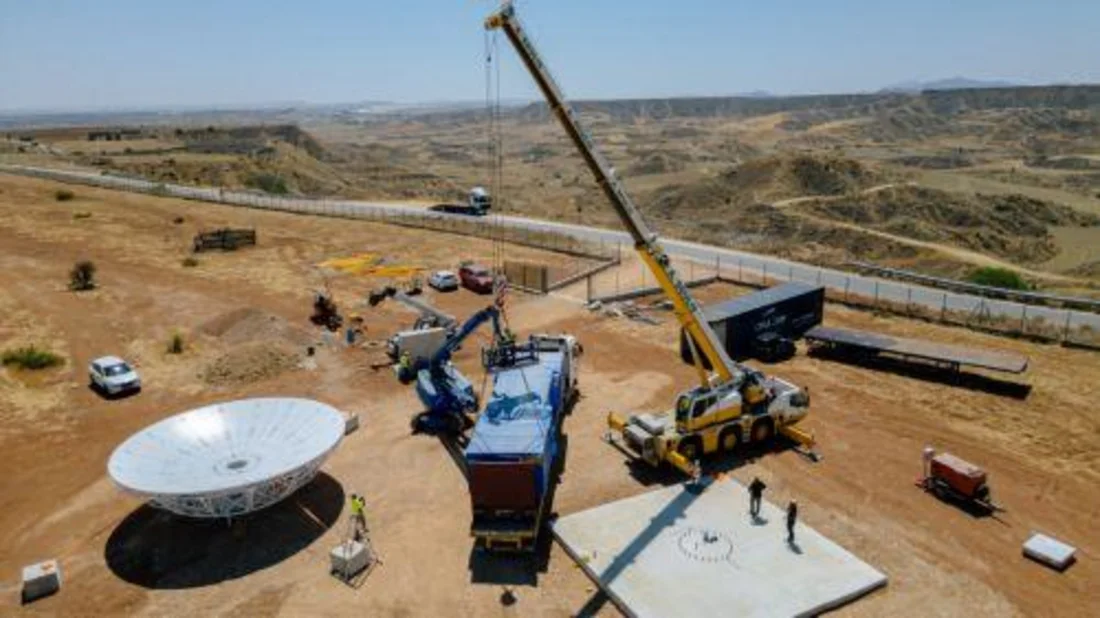
Towards the First Cyprus Advanced Earth Observation Satellite Data Acquisition Antenna
July 2, 2025 | by admin from
Cyprus reached a major milestone in its space and Earth Observation capabilities with the arrival of the country’s first advanced Data Acquisition Station (DAS) antenna. The infrastructure represents a significant investment in national space technology capacity, enabling Cyprus to directly receive satellite data and strengthen its role as a regional hub for Earth Observation services.
The new satellite data receiving antenna forms part of a long-term effort to establish advanced Earth Observation infrastructure in Cyprus through the ERATOSTHENES Centre of Excellence. The investment, valued at approximately €3.9 million, represents one of the most important technological upgrades in Cyprus’ remote sensing capabilities.
Unlike conventional satellite data access methods that rely on downloading information from external repositories after a delay, the new acquisition station provides Cyprus with the ability to receive satellite observations directly as satellites pass over the region. The system has advanced technical capabilities, including the simultaneous reception of data across three different frequency bands from low-Earth-orbit satellites, allowing faster and more flexible access to high-resolution Earth Observation products.
The availability of near real-time satellite data will significantly enhance Cyprus’ ability to monitor and respond to environmental and societal challenges. Applications include natural disaster management, wildfire monitoring, flood assessment, drought analysis, climate monitoring, maritime surveillance, agricultural monitoring, and ecosystem management. Rapid access to satellite imagery allows authorities and researchers to identify changes on the ground more efficiently and support faster decision-making during emergencies.
The new infrastructure also strengthens Cyprus’ strategic position within the Eastern Mediterranean and Middle East region. Due to its geographic location, Cyprus is ideally positioned to serve as a bridge between European space programmes and regional environmental monitoring needs. The station supports existing and future satellite missions while creating opportunities for scientific collaboration, innovation, commercial Earth Observation services, and the development of new space-related applications.
Beyond scientific research, the antenna represents a key component of Cyprus’ transition towards a data-driven approach to environmental management and climate resilience. By combining satellite observations with artificial intelligence, geospatial analysis, and advanced modelling techniques, the country can develop new services supporting sustainable development, infrastructure protection, and informed policy-making. The infrastructure marks an important step in transforming satellite data into practical solutions for society, industry, and public authorities.