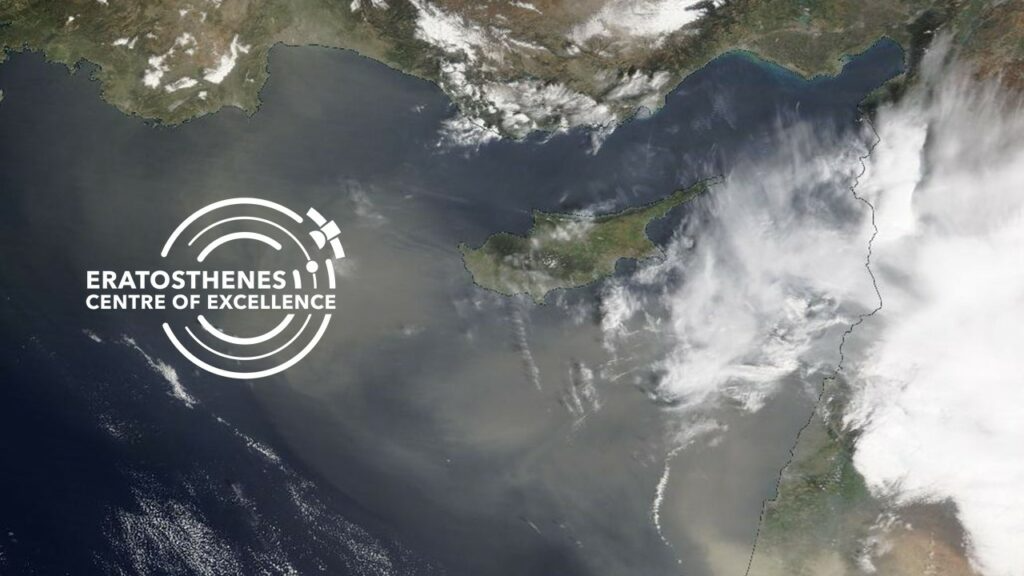
Middle East Dust Cloud and its impact on Visibility Across Cyprus
March 5, 2025 | by admin from
A dense dust cloud is sometimes transported from the Middle East spread across Cyprus, significantly reducing visibility and deteriorating air quality, particularly in Limassol and other southern coastal areas. Such events are driven by strong north-easterly winds carrying large quantities of suspended mineral dust across the Eastern Mediterranean, creating hazy skies and limiting visibility in several parts of the island. Satellite imagery, atmospheric dispersion models, and ground-based monitoring stations are used to track the movement and concentration of the dust plume as it reached Cyprus.
Scientists at Eratosthenes Centre of Excellence are monitoring these events by using a combination of satellite observations and atmospheric measurements, producing maps illustrating both dust concentration and visibility across the region. These analyses are showing that some areas experience visibility of less than 5 kilometres, while regions less affected by the dust maintain visibility exceeding 25 kilometres. Such integrated Earth Observation products enable meteorologists to assess the intensity of airborne dust events, forecast their evolution, and provide timely information to authorities and the public.
Dust intrusion episodes are relatively common in Cyprus due to its geographical position between Europe, Asia, and Africa, where air masses frequently transport mineral dust from the Sahara Desert and the Middle East. However, high-concentration events can have significant environmental and public health impacts. Fine dust particles (PM₁₀ and PM₂.₅) can aggravate respiratory and cardiovascular conditions, reduce visibility for road and air transport, and influence atmospheric radiation by scattering and absorbing sunlight. During such events, public health authorities typically advise vulnerable groups—including children, older adults, and individuals with respiratory illnesses—to limit outdoor activities until air quality improves.
Dust incidents also highlight the critical role of Earth Observation technologies in operational environmental monitoring. By combining satellite imagery, atmospheric models, meteorological observations, and air quality measurements, scientists can track transboundary dust transport in near real time, improve weather forecasting, support civil protection authorities, and assess the broader impacts of climate variability on the Eastern Mediterranean. As climate change is expected to increase the frequency and intensity of extreme atmospheric events, integrated monitoring systems are becoming increasingly important for protecting public health, improving environmental resilience, and supporting evidence-based decision-making.